


The Upgrading Program is a support and assistance scheme designed to strengthen the capacities of agricultural cooperatives and value-addition units, with the aim of professionalizing their activities and facilitating their access to markets. It seeks to improve governance, product quality, regulatory compliance, and marketing practices, while enhancing the economic viability of cooperatives. The program also integrates essential elements that enable cooperatives to gain sustainable access to local, national, and international markets.
To benefit from the Upgrading Program, groups (cooperatives, unions of cooperatives, or Economic Interest Groups) must submit their application to the relevant Regional Directorates of Agriculture.
Various investment opportunities are available to investors in the agricultural sector under the Generation Green 2020-2030 strategy, throughout the agricultural value chains. These opportunities notably include:
The Moroccan Contest of Local Products aims to promote Moroccan local products and showcase the expertise and know-how of producers.
It highlights the quality of local products, encourages excellence, and enhances the visibility of producers in both national and international markets.
The competition also serves as a platform to recognize and promote innovative initiatives in the field of local products.
Investors in the agricultural sector benefit from a favorable business climate on economic, regulatory, institutional, and logistical levels through:
The Moroccan Competition for Local Products is open to all producers of local products, including farmers, individual producers, cooperatives, Economic Interest Groups (EIGs), processing companies, and others. The main eligibility requirement is that the product has a verifiable and recognized link to its local area of production (terroir).
Participants are classified into two categories:
Producers wishing to participate may register by completing the online application form or by contacting the Regional Directorates of Agriculture.
To obtain authorization to use the "TERROIR DU MAROC" collective label, you must be a producer and/or packer (either a natural or legal person) of Moroccan local agricultural products (terroir products).
You must also operate a clearly identified processing and value-addition unit located within the product’s region of origin and have your registered headquarters in Morocco.
Investors wishing to benefit from financial assistance under the Agricultural Development Fund (FDA) must submit their applications at the one-stop counters of the Provincial Directorates of Agriculture (DPA) or Regional Offices for Agricultural Development (ORMVA) in their area of operation, following these main steps:
To obtain this authorization, you must submit an application file to the Agricultural Development Agency (ADA).The application file will be reviewed by an Approval Committee chaired by the ADA and composed of representatives from the ADA, DDFP, ONSSA, EACCE, ONCA, LOARC, and the Regional Directorates of Agriculture (DRAs).The authorization to use the collective label is issued by the ADA for a renewable period of three years.
The authorization to use the collective label “Terroir du Maroc” is obtained by submitting an application file to ADA containing the following documents:
Regarding the leasing of agricultural land under public-private partnerships, this concerns long-term leases (17 to 40 years) intended for agricultural projects, subject to a specific set of requirements. These lands, which belong to the State’s private domain, are leased through calls for tenders launched periodically by the National Agency for Agricultural Development on its official website: www.ada.gov.ma.
You are therefore encouraged to regularly consult the website to stay informed about new opportunities in the available land portfolio.
The consultation regulations for each call for tenders detail the conditions, procedures, and criteria set by the Administration for selecting the bidder who will enter into a partnership agreement with the State.
Displaying the "TERROIR DU MAROC" collective label on Moroccan local products provides:
An aggregation project in the citrus sector may be structured around a packing and/or processing unit. It must also meet the eligibility criterion relating to the minimum number of aggregated farmers (25 aggregated farmers).
Access to modern distribution channels is an essential lever for enhancing the visibility of local products and improving their competitiveness.
Through partnerships with major retailers such as Carrefour, Marjane, Aswak Assalam, and the Oasis Solidarity Market, local products are brought closer to consumers and benefit from a guaranteed presence in supermarkets and large retail stores.
All developing countries that are Parties to the United Nations Framework Convention on Climate Change (UNFCCC) are eligible to receive financing from the Green Climate Fund (GCF). GCF financing is channelled through accredited entities that develop and implement projects and programmes.
Any public entity, or any entity capable of submitting proposals through a public entity and possessing adequate implementation and management capacities, may submit project proposals to the Agricultural Development Agency (ADA). ADA primarily operates in the agricultural sector. However, projects related to climate change mitigation or adaptation in other economic sectors may also be submitted to ADA for review, particularly those in the water sector, territorial planning, and other relevant fields.
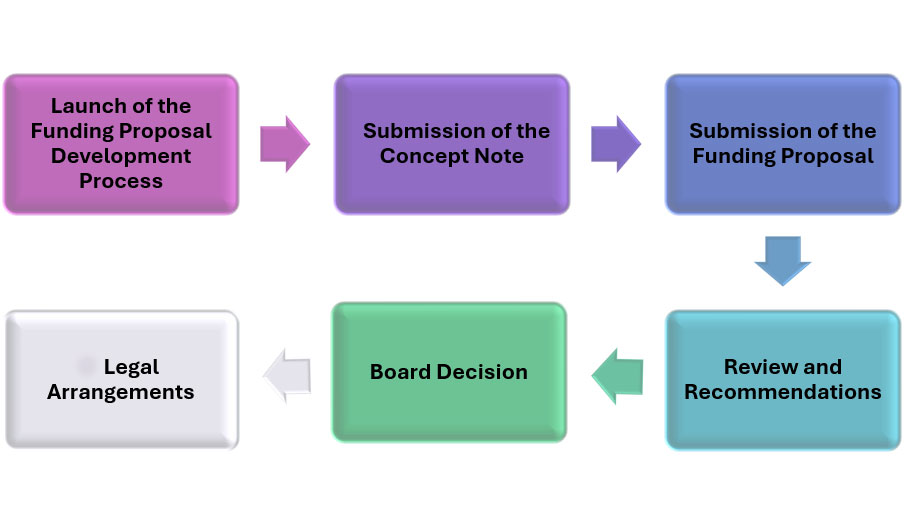
Accessing GCF financing follows a well-defined process. The time required between the initial submission and the Board’s funding decision depends largely on the quality of the proposal. Well-prepared and robust proposals generally progress through the approval process more quickly.
Cooperatives benefit from technical and logistical support that facilitates the integration of their products into modern marketing channels.
These partnerships also ensure permanent exposure of local products on supermarket shelves, allowing consumers to purchase them directly, without intermediaries.
Needs Assessment by Large and Medium-Sized Retail Chains (GMS):
Based on annual meetings with retail partners.
Identification and Selection of Producer Groups/Suppliers According to GMS Requirements:
Selection is based on several criteria, including:
Contacting the Selected Producer Groups and Explaining the Required Procedures;
Preparation of the Initial Listing Application for the GMS Purchasing Committee:
The application includes:
Preparation of the Final Listing Application Following Approval of the Initial Submission:
The application includes:
Signing Contracts and Launching Purchase Orders;
Training and Supporting the Team Responsible for the Brand;
Supporting the First Order and the Integration of Products into Retail Stores.
To obtain aggregator status, the aggregator submits an application for approval of the aggregation project, along with a project file, to the Regional Directorate of Agriculture (DRA) where the project is domiciled, for approval by a technical committee. Once the project file is approved, the aggregator submits a supplementary project file to the same DRA. This file is validated by the DRA and forwarded to the ADA for the issuance of aggregation certificates for the benefit of the aggregator and the aggregated farmers.
Producers of terroir products must get in contact with the terroir products service within the Regional Directorates of Agriculture to submit their participation requests.
Producers’ groups must meet the following criteria:
Climate finance providers, such as the Green Climate Fund (GCF) and the Adaptation Fund, apply rigorous evaluation criteria to ensure that mobilized resources effectively contribute to combating climate change and promoting sustainable development. While requirements may vary across financing mechanisms, several key criteria are systematically assessed during project appraisal, including:
To ensure effective and successful participation in international trade fairs, selected exhibitors benefit from a dedicated coaching programme provided by the ADA. The programme focuses on the organizational, technical, and commercial requirements associated with international exhibitions.
The coaching sessions cover all key administrative and regulatory procedures related to exporting local products, including shipping formalities, sanitary and phytosanitary certificates, export inspection certificates, Material Safety Data Sheets (MSDS), customs requirements, and regulatory monitoring for target markets. Participants also receive guidance on visa application procedures and entry requirements for host countries.
In addition, the programme is designed to strengthen exhibitors' capacity for international business development. It provides practical training on market prospecting, conducting B2B business meetings, building long-term commercial partnerships, sales and negotiation techniques, commercial communication tools, and understanding the expectations of international buyers. Participants are also introduced to best practices for promoting and positioning Moroccan local products in international markets.
An aggregated farmer may join an aggregation project by signing an aggregation contract with the aggregator. Said contract must include the mandatory clauses defined by Law 04-12, notably:
For aggregated farmers, the State grants subsidies at preferential rates for the acquisition of agricultural and livestock equipment (e.g., for tractors: 40% with a ceiling of MAD 96,000 instead of 30% with a ceiling of MAD 72,000 under the universal scheme), as well as for equipment for localized irrigation systems and/or supplementary irrigation systems (95% instead of 75% under the universal scheme for farmers operating an area of less than or equal to 20 hectares, and 80% instead of 60% under the universal scheme for farmers operating an area greater than 20 hectares).
To benefit from this subsidy, aggregated farmers must attach copies of valid aggregation certificates to their subsidy application files. After delivering the production to the aggregator, and in order to benefit from the additional subsidy amount, aggregated farmers must submit a clearance certificate issued by the aggregator attesting to the delivery of the production to the aggregator.
New Generation Solidarity Agriculture projects target small farmers and livestock breeders, as well as rural youth and women living in oasis, mountainous, arid, and semi-arid areas. To benefit from these projects, applicants should contact the territorial services of the Ministry of Agriculture operating in their area (Regional Directorate of Agriculture, Regional Directorate of Agricultural Advisory Services, Regional Office for Agricultural Development, or Provincial Directorate of Agriculture) and submit an official application. This application will be reviewed as part of the programming of upcoming Solidarity Agriculture projects.
Solidarity-based agriculture contributes to sustainable development in rural territories by promoting inclusive economic growth, creating local employment, and enhancing high-potential agricultural value chains. It also encourages sound management of natural resources, strengthens rural territories’ resilience to climate change, and supports the emergence of sustainable income-generating activities, thereby improving living conditions in rural areas.
If you farm a small agricultural area in an oasis, mountainous, arid, or semi-arid zone, you may benefit from support within the framework of Solidarity Agriculture.
The proposed support mainly includes the planting of fruit trees and the distribution of seedlings, the development of water points and hydro-agricultural infrastructure, the establishment of value-addition units and agricultural tracks, as well as advisory, training, and capacity-building activities.
Livestock breeders may also benefit from support under the development of animal production value chains, such as the establishment of milk collection centers, fattening units, rangeland improvement, and zootechnical support.
Agricultural cooperatives can engage directly with the Ministry’s territorial services to express their needs. They may benefit from targeted support such as equipping value-addition units, constructing production facilities, as well as receiving technical and organizational assistance.
These forms of support aim to strengthen governance, sustainability, and competitiveness of cooperatives in rural areas.
Young farmers or livestock breeders can benefit from agricultural development projects focusing on plantation, livestock farming, or the valorization of products. For unemployed youth, Solidarity Agriculture offers opportunities for inclusion and empowerment through the establishment, for the benefit of youth cooperatives, of income-generating activities (IGAs), technical and financial support to agricultural and para-agricultural service cooperatives, as well as training and coaching actions to strengthen their entrepreneurial skills.
Rural women active in agriculture or livestock farming can benefit from support like that provided to small farmers, particularly in the areas of production, value addition, and marketing. Women who do not yet have an activity can benefit from economic empowerment initiatives under Solidarity Agriculture, aimed at strengthening their inclusion and financial independence. These initiatives include, among others, the establishment of processing and value-addition workshops for products, support for the creation and strengthening of women’s cooperatives, and the development of income-generating activities that promote their economic and social integration.
It is an initiative under the Generation Green strategy that supports young people in the agricultural sector by helping them create their own projects and generate income.
Each region has a Regional Center for Young Agricultural and Agri-food Entrepreneurs, equipped with dedicated teams and tools to guide and support you throughout all stages of your entrepreneurial project.
The program offers a comprehensive support package covering technical, administrative, and financial aspects. This includes support for idea development, pre-startup assistance, help in accessing financing, as well as post-startup support to accelerate growth and ensure the sustainability of your business.
You will learn how to develop a business plan, manage a company, mobilize financing, and strengthen your technical and managerial skills tailored to your project.
You can access government support through the Agricultural Development Fund, financing schemes for young users of collective land, Solidarity Agriculture projects, and other mechanisms such as honor loans, guaranteed loans with subsidized interest rates, the National Initiative for Human Development (INDH), and other government programs.
Register on www.chababagri.ada.gov.ma, visit a Regional Center or a Provincial Agricultural Advisory Service, and take part in workshops, awareness caravans, and calls for projects to start your entrepreneurial journey.
Climate finance refers to all public and private funding mobilized to support actions to mitigate climate change (reducing GHG emissions) and adapt to its impacts, particularly in agriculture, water, energy and the ecosystems.
Mitigation aims to reduce the causes of climate change, primarily by lowering greenhouse gas emissions.
Adaptation involves strengthening the resilience of natural and human systems to the impacts of climate change, both observed and anticipated.